I saw the news and thought, here we go again
Got a Fanatec CSL DD on your rig? Then you know that little pit in your stomach when the news broke that Corsair bought Fanatec. Not because your wheelbase will spontaneously combust tomorrow. But because plenty of sim racers still remember Fanatec’s RMA disaster from 2023 like it was yesterday. Weeks-long wait times. Customer service that never called back. Parts that simply weren’t in stock because the company was, let’s be polite about it, financially on its last legs.
So when that GTPlanet thread blew up to well over a thousand comments of pure anxiety, I got it completely. People who just dropped 800 euros on a GT DD Pro want to know one thing: will this brand even exist next year?
Short answer: probably better than ever. The long answer needs some context.
What Actually Happened (Minus the Noise)
Fanatec, officially Endor AG, had been in rough shape for a while. Insolvency proceedings in Germany, restructuring, a sale process that hung over the market for months. This wasn’t some secret. It was literally in the press. Corsair, known for PC cases, RAM, gaming keyboards, and that iCUE software half of reddit has a love-hate relationship with, stepped in as the buyer.
And honestly? That’s good news. Corsair isn’t a vulture fund looking to strip the brand for parts and dump it. It’s a company that’s been building hardware for years, has its own distribution network and, more importantly, actually has money. They’re not buying Fanatec to kill it. They’re buying it because sim racing is a growth market, and Fanatec is one of the few brands with a genuinely strong ecosystem: wheelbases, pedals, wheels, shifters, all compatible with each other.
Why Everyone’s Still Scared
Let me be honest: the fear isn’t irrational. People watched Fanatec wobble. They waited weeks for replacement parts. They’ve seen what happens to other acquired gaming brands before: product lines quietly disappearing, support teams getting gutted after a buyout.
But here’s the difference. Fanatec had an acute cash problem. That’s now solved, or at least massively improved, because there’s a big, solvent company behind it now. That’s not the same thing as “the company is shutting down.” It’s almost the opposite scenario.
What Actually Changes for Your Warranty and Support?
I need to be careful here, because nobody has a crystal ball. Me included. But based on how acquisitions like this usually play out, there are a few things you can reasonably expect.
Existing warranties usually stay valid. In an acquisition, the buying company typically takes on the obligations of the acquired brand, including active warranties. And separately from that: as a consumer in the EU you have statutory rights against the shop you bought from. Those don’t depend on who happens to own Fanatec.
Customer service might be messy for a while. Reorganizations take months. Don’t expect the RMA process to run smoothly over the next few weeks. Realistically, it’ll take somewhere between six months and a year before processes, teams, and inventory management settle back to normal.
Product lines will probably shrink, not grow. Corsair isn’t going to keep supporting every obscure Fanatec accessory from 2019. Expect them to focus on the popular, profitable lines: the direct drive wheelbases, the well-known pedal sets, the bundles that actually sell.
Software will probably get a facelift. Corsair has experience with iCUE. Expect Fanatec’s software to eventually get folded into a broader Corsair ecosystem. Could be better. Could also mean a rough patch of bugs during the transition. That’s just how software migrations go. Always.
Should You Still Buy Fanatec? Yes. Seriously.
Here’s where I stick my neck out, and I know not everyone will agree. But I think this is actually a good moment to buy Fanatec gear, not a bad one.
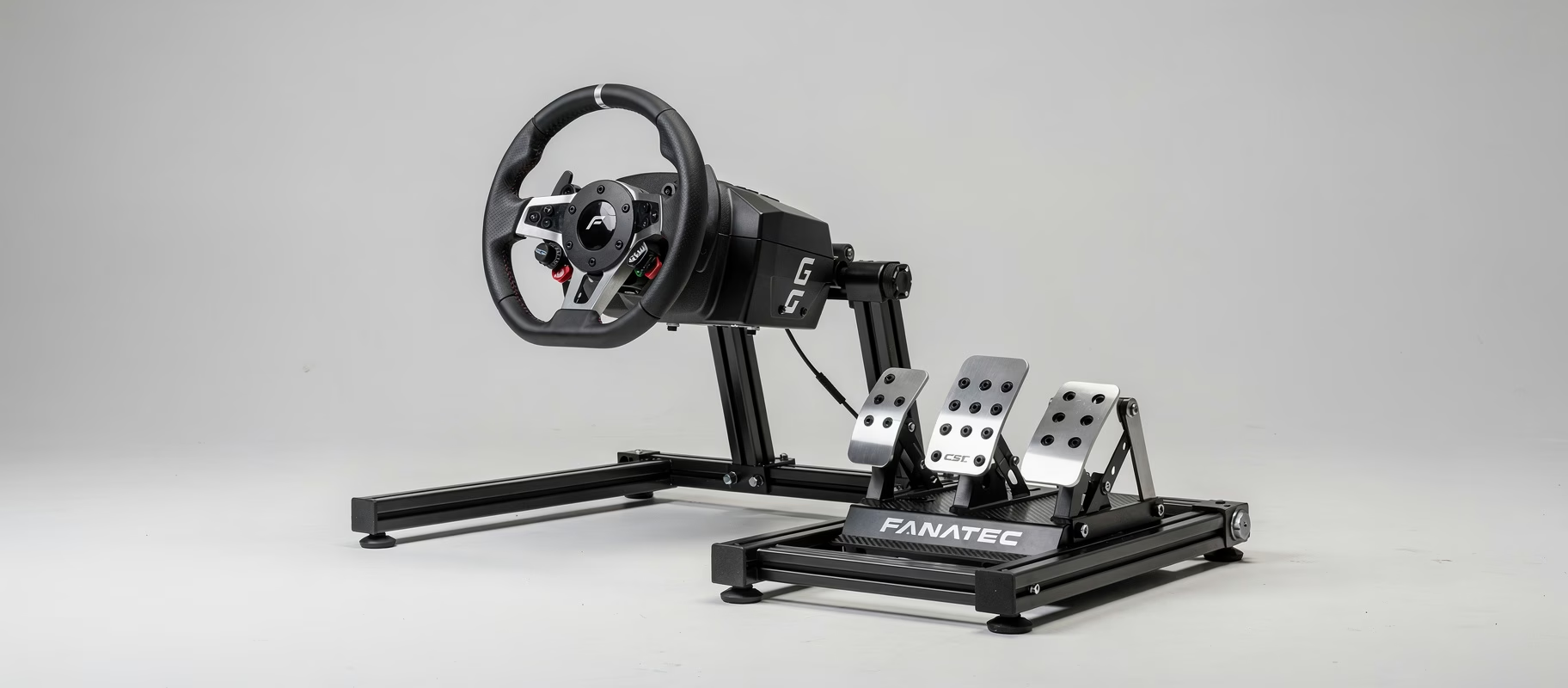
Why? Because the products themselves haven’t changed. The Fanatec GT DD Pro is still one of the only direct drive bundles with an official PlayStation license, packing 5 to 8 Nm of force (with Boost) and that signature Fanatec quietness you just don’t get from cheaper brands. Who owns the company doesn’t change any of that.
The big ecosystem advantage of Fanatec (upgrading your wheel, wheelbase, and pedals separately without rebuying everything) still stands too. Take the Fanatec CSL Pedals. Entry-level, metal frame instead of plastic (which matters, because plastic pedals flex and feel cheap), and you can add a load cell kit later once your budget allows it. That kind of modularity is exactly why people have chosen Fanatec for years, and that business model isn’t going anywhere under Corsair.
Want better brake feel right out of the box? Look at the Fanatec CSL Elite Pedals V2, with a load cell included standard and adjustable spring resistance. Not cheap, but the kind of pedal set you’ll use for years without itching to upgrade again.
And if you want to go all the way: the Fanatec ClubSport Pedals V3. Full metal construction, 90kg load cell, vibration motors in both pedals. This is the set for people who are genuinely serious about it. Overkill for the average hobbyist? Maybe. But if you’re serious about it, you’ll feel the difference immediately.
What if You’re on Xbox?
This is where it gets interesting, because Fanatec is one of the only brands with a real Xbox license for direct drive hardware. The Fanatec CSL DD Ready2Race Bundle gets you a 5 Nm CSL DD wheelbase, a McLaren GT3 V2 wheel (Xbox-licensed, which is rare), and the CSL Pedals, all plug-and-play. Is 5 Nm on the low side for heavy GT3 simulations? Yeah, honestly, it is. But for Xbox players the competition is thin, and this is still one of the best entry points out there.
What I’d Actually Do in Your Position
If you already own Fanatec hardware: relax. Your warranty doesn’t vanish overnight. Keep your receipt (always good advice, acquisition or not) and keep an eye on official Fanatec communications over the next few months.
If you’re thinking about buying: go for it. The risk of the brand disappearing tomorrow is actually lower now, not higher. In fact, I’d expect customer service to improve over the medium term compared to the last two years, simply because there’s now a company behind it that can actually pay its bills.
What I would be cautious about: don’t expect every old accessory or niche model to survive. Big players like Corsair trim product lines to stay profitable. That’s just how acquisitions work. Focus on the popular, current models (the wheelbases and pedal sets everyone actually buys) instead of that one obscure accessory that’s been nearly sold out for three years.
The panic on GTPlanet is human. Nobody wants to end up with a broken wheelbase and a dead brand. But this acquisition isn’t the end of a story. It’s more like the moment someone with deep pockets finally paid a bill that had been sitting open for way too long.